Farm tea Sabah Nalapak village located in the district of
Ranau , about 120 kilometers from the city of Kota Kinabalu , Sabah . This tea
plantation is located on highway between Telupid - Ranau ie after crossing to
Poring Hot Spring . Tea plantation is in the height of 2,272 feet above sea
level with an area as large as 6,200 acres of farm. The area is surrounded by
tea plantations forest that has been around since 130 million years ago. In
addition, this tea plantation backdrop of Mount Kinabalu and is the sole
organic tea plantation in Malaysia as well as the choice in the world.
Tuesday, 6 August 2013

Sepilok Orang Utan In Sandakan
The Sepilok Orang Utan Rehabilitation Centre was set up in
1964 to rehabilitate orphaned baby orang utan. Set in the lush 4,300-hectare
Kabili-Sepilok Forest Reserve, the Centre under the administration of the
Wildlife Department of Sabah attracts tourists and researchers alike, giving
them the opportunity to watch the orang utan up close in their natural habitat.
A boardwalk leads you to a viewing gallery and feeding platform where the apes
are fed milk and bananas twice a day at 10.00am and 3.00pm by rangers. Feeding
time also attracts long-tailed macaques to the area.
While orang utan rehabilitation is still the primary goal at
Sepilok, it also focuses on public education on conservation, research and
assistance on other endangered species such as the rhinoceros.
Maize Festival @ Pesta Jagung
The Pesta Jagung or maize fesival is held in the district of
Kota Marudu, about 130 km or two hours drive from Kota Kinabalu. Just like
other agriculture-based celebrations, this fest promises to be another exciting
event that should not be missed by any visitor to Sabah.
Maize or jagung is one of the many agricultural products in
the state that has provided an important economic contribution to the lives of
mainly the Kadazandusun communities in Kota Marudu. This event serves to
highlight the significance of this plant to the people. Of course there will be
plenty of fun too with jagung cooking and planting competitions, cultural shows
and the Jagung Fashion Queen!
So visit this district to join in the excitement and
discover the unique lives of the people of Kota Marudu.
Agnes Keith House
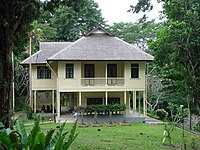
If you should ever stroll along the stretch of Jalan Istana
in Sandakan, the much-talked about Agnes Keith House is hard to miss. With its
sprawling green lawns and colonial-style wooden walls, the residence has since
been restored by the Sabah Museum, in collaboration with the Federal Department
of Museums and Antiquities.
This British colonial government quarters, called Newlands,
was once occupied by famous American writer, Agnes Newton Keith, who penned
Land Below The Wind in 1939. Two books followed her first success, namely Three
Came Home (1946) and White Man Returns (1951). With the exception of the second
book, Land Below the Wind and White Man Returns were written in the house on
the hill where she had the best views of Sandakan Bay at the front and the Sulu
Sea at the back.
Newlands was rebuilt some time in 1946/47 and was the first
government permanent timber dwelling to be built after the Second World War. It
was built upon the ruined foundations of the original house that was destroyed
during the war.
The house became home to Agnes and her family, Henry (also
referred to as Harry) George Keith, who was the Conservator of Forests and
their son, George. When the Keiths left Sabah in 1952, the house was occupied
by subsequent Conservators of Forests, forestry officers, volunteers and other
staff. Though the Keiths never retuned to Sabah, the house was always referred
to as Agnes Keith's House by visitors who never stopped coming to see it.
Today the house has been restored and turned into a heritage
house, providing interesting insights to life during British North Borneo. It
is furnished with a reproduction of colonial furniture and antiques. A gallery
on the first floor tells the story of this remarkable woman, her books and her
family. A Keith time-line starts in 1873 and ends in 2004 tracing the past to
the present Keiths.
Races In Sabah (Multiple Ethnics)
Sabah is a unique land, a melting pot of many indigenous and
immigrant groups. The population comprises over thirty-one different ethnic
races and 80 over different languages or dialects. The beautiful thing is all
these diverse ethnic groups live together harmoniously while at the same time
preserving their own culture, traditions, festivals and customs. The indigenous
group in Sabah include the Kadazan Dusun, Bajau, Murut, Rungu, Lotud, Brunei,
Orang Sungai, Kadayan, Bisaya and many others sub-groups.
The Chinese form
the largest non-indigenous group. The largest single Chinese group in Sabah are
Hakka(Kek), although Cantonese, Hokkien, Teochew, Hainanese, Henghua and other
groups found. The Chinese have intermixed with the local population, mainly the
Kadazan Dusun, often creating the confusing situation ethnically whereby a
person with a Chinese name may not be Chinese. This may only be an indication
of some Chinese ancestry. He may be Kadazan in appearance, culture and
language.
The largest ethnic
group, the Kadazan Dusun make up about a third of the population are found
mainly on the West Coast from Kudat to Sarawak border and in the interior areas
of Ranau, Tambunan and Keningau. These are the prosperous agricultural rice
producers of Sabah, although in recent times, many have found success in modern
professions. They are well known for their unique customs that feature female
priestesses called "bobohizan" presiding over still practised ancient
rituals. They are many sub-groups, which include the Rungus, Lotuds, Tambanuos,
Kimarangans, Sanayos, Minokoks, Orang Sungai, Kuijau and Tenggeras. The
majority of the Kadazan Dusun people are Christians.
The Bajaus, the
second largest indigenous group are believed to have come to Sabah around the 18th
and 19th centuries from the Southern Philipines. The Bajaus have often been
called sea gypsies because they were fearless sailors. But nowadays they are
the famous 'Cowboys of the East' as they are expert horsemen rearing ponies,
buffaloes and cattle as well as being as rice farmers. On festive occasions,
they will be riding brightly on decorated ponies.
The Muruts, third
largest indigenous group live mostly in the South West region of Sabah and
remote parts of the interior residency between the town of Keningau, Tenom and
Pensiangan. The Muruts were great hunters, using spears, blowpipes and poisoned
darts and dogs; once feared for their head hunting. Some of the Murut tribes
included the Nabai, Bokan, Tagal, Nabas and Timogun. Some Muruts still practice
shifting cultivation, living in the more remote areas.
Monday, 5 August 2013
Kaamatan Festival

Kaamatan festival is an annual event in the cultural life of
the Kadazandusuns of Sabah since time immemorial. In its deepest sense,
Kaamatan festival is a manifestation of Creator and Creation relationship, as
well as Inter-Creations relationship. It embodies the principal acts of
invocation of divinities, appeasing, purification and restoration, re-union of
benevolent spirits, and thanksgiving to the Source of All. It is part of a
complex wholesome Momolian religious system centered on the paddy rites of
passage and the life cycle of Bambarayon - the in-dwelling spirit of paddy.
Appeasing is done in respect of Bambarayon, Deities,
Divinities and Spirits, who may have been hurt by human wrongful, acts.
Purification is performed in respect of human and spiritual needs for
forgiveness followed by resolutions to make themselves worthy of the gifts of
life from God. Restoration in necessary to ensure the health and well being of
sunduans, mankind and other spiritual beings. Re-union is realised in respect
of human needs to be integrated in body, mind and spirit within the concept of
the seven-in-one divinity in humanity, as well as re-union of Bambarayon with
human Sunduan. Finally Thanksgiving is observed as befitting for all creations
to express their gratitude and appreciation for the gifts of life (through
Huminodun) and all life supportive system on earth that their Creator lovingly
and generously gave them.
Noonsom Sabah

Noonsom Bambangan(Bambangan Fruit)
Noonsom is one of a special traditional meal for the tribe
Kadazan-Dusun , Sabah , also known as citrus in Malay. There are several types
Noonsom in Kadazandusun cuisine, one of the most popular is Noonsom Sada
(Fish), Noonsom Bambangan (fruit) and Noonsom Tuhau (side dish).
Noonsom Sada - Fish used was kind of freshwater fish,
cleaned and preserved using Pangi pulp (crushed), rice and salt.
All the materials are mixed and filled into bottles / small
tajau and leave it for ten or twelve days before serving.
Noonsom Bambangan - Fill Bambangan sliced fruit and seeds
mixed with the grated Bambangan and a little salt.
When all the ingredients are mixed, fill into bottles or
small tajau and leave it for a week before eating.
Noonsom Tuhau - Fill Tuhau (a plant) sliced and pickled
with vinegar , salt and cayenne pepper.
When all the ingredients have been mixed, fill up the
bottles and leave a few minutes before serving.

Noonsom Tuhau(Vegetable)
Hinava (Fish Salad)

Hinava or Hinava Ginapan is one of the traditional dishes
special to tribes Kadazan-Dusun , Sabah , and may be regarded as a food of the
most popular among the Kadazan-Dusun.
It is a dish made from fresh fish meat mixed with beans Bambangan the grated fruit, red chillies, ginger , onion, lime cotton and salt .
The fish will not be cooked because it will cook with lemon juice extraction using either lime or calamansi (resembling shushi).
There are many different types of fish that can be used, but usually the fish mackerel, shark, although the content can also be used. Additionally contents squid or shrimp can also be used for the preparation of this Hinava.
Hivana usually a special dish during Tadau_Kaamatan . In addition, it is also a special dish on important occasions such as for wedding, engagement etc..
It is a dish made from fresh fish meat mixed with beans Bambangan the grated fruit, red chillies, ginger , onion, lime cotton and salt .
The fish will not be cooked because it will cook with lemon juice extraction using either lime or calamansi (resembling shushi).
There are many different types of fish that can be used, but usually the fish mackerel, shark, although the content can also be used. Additionally contents squid or shrimp can also be used for the preparation of this Hinava.
Hivana usually a special dish during Tadau_Kaamatan . In addition, it is also a special dish on important occasions such as for wedding, engagement etc..
Kinabalu Park Before the Mount Kinabalu

Kinabalu Park was gazetted as the first State Park in Sabah
in 1964 and declared Malaysia’s first World Heritage Site by UNESCO in the year
2000 for its outstanding biological attributes. A sprawling 75, 400 hectares,
this melting pot of natural wonders is larger than Singapore.
Also the Centre of Plant Diversity for South East Asia, the
Park boasts more than 5,000 vascular plant species, an estimated 1,000 orchid
species, 621 fern species, nine Nepenthes species, 29 Rhododendron species and
two Rafflesia species. The Park has no shortage of fauna as well, being home to
some 90 lowland mammal species, 22 montane mammal species, 21 bat species, 326
bird species, 62 toad and frog species and a large population of the 850
butterfly species that occur in Sabah. Out of the 29 bird species that are
endemic to Borneo, at least 17 are confined to the mountains, notably Mount
Kinabalu. These include subspecies of the Red breasted Tree-partridge,
Crimson-headed Wood-partridge and Mountain Blackbird. Such diversity is truly
the makings of a naturalists’ paradise!

The main attraction at the Park is
none other than the majestic Mount Kinabalu, one of the highest mountains in
South East Asia standing at 4095.2 metres. Apart from traditional mountain
climbing, visitors can also experience the Mountain Torq, the world’s highest
and Asia’s first Via Ferrata or ‘iron road’ at 3,200m to 3,800m above sea
level. The various routes on the northern rock faces of Mount Kinabalu consist
of a ‘trail’ that is made up of iron rungs, palettes, cables and rails.
Depending on the preferred difficulty level, visitors can enroll in various
activities such as the intro to single pitch or multi pitch sports climbing,
intro to rappelling (abseiling) and introduction to rope ascending. Mount Kinabalu
attracts thousands of climbers from around world every year and is also the
venue of the annual Mount Kinabalu International Climbathon.
Surrounding the Kinabalu Park is a
multitude of natural attractions and enjoyable activities. The Kinabalu Natural
History Gallery is a great place to familiarize with what the Park has to offer
to through a fascinating exhibition on the flora, fauna and geological make-up
of the Park. Video presentations are screened daily at the Liwagu’s Visitors
Centre and guided tours are also available. Approximately half an hour from the
Kinabalu Park headquarters is the Poring Hot Springs, located 400m above sea
level. It features hot sulphur spring baths claimed to have therapeutic values,
a 41-metre canopy walk where visitors can hike among the towering canopies, the
refreshing Kipungit and Langanan waterfalls, various gardens, a butterfly farm
and an orchid conservation centre. In Mesilau, hike along the acclaimed Mesilau
trail where you can spot various pitcher plants particularly the Nepenthes
lowii, Nepenthes tentaculata and Nepenthes rajah.
The Mount Kinabalu (Gunung Kinabalu)

Mount Kinabalu
(Gunung Kinabalu in malay) is a prominent mountain on the island of Borneo in
Southeast Asia. It is located in the East Malaysian state of Sabah and is
protected as Kinabalu National Park, a World Heritage Site. Kinabalu is the
highest peak in Borneo's Crocker Range and is the highest mountain in the Malay
Archipelago. Mount Kinabalu is also the 20th most prominent mountain in the
world by topographic prominence.
In 1997,
a re-survey using satellite technology established its summit (known as Low's
Peak) height at 4,095 metres (13,435 ft) above sea level, which is some 6
metres (20 ft) less than the previously thought and hitherto published figure
of 4,101 metres (13,455 ft).
Mount Kinabalu
includes the Kinabalu montane alpine meadows ecoregion in the montane
grasslands and shrublands biome. The mountain and its surroundings are among
the most important biological sites in the world, with between 5000 and 6000
species of plants, 326 species of birds, and more than 100 mammalian species
identified. Among this rich collection of wildlife are famous species such as
the gigantic Rafflesia plants and the orangutan. Mount Kinabalu has been
accorded UNESCO World Heritage status.
Low's
Peak can be climbed quite easily by a person in good physical condition and
there is no need for mountaineering equipment at any point on the main route.
Other peaks along the massif, however, require rock climbing skills.
Subscribe to:
Posts (Atom)